

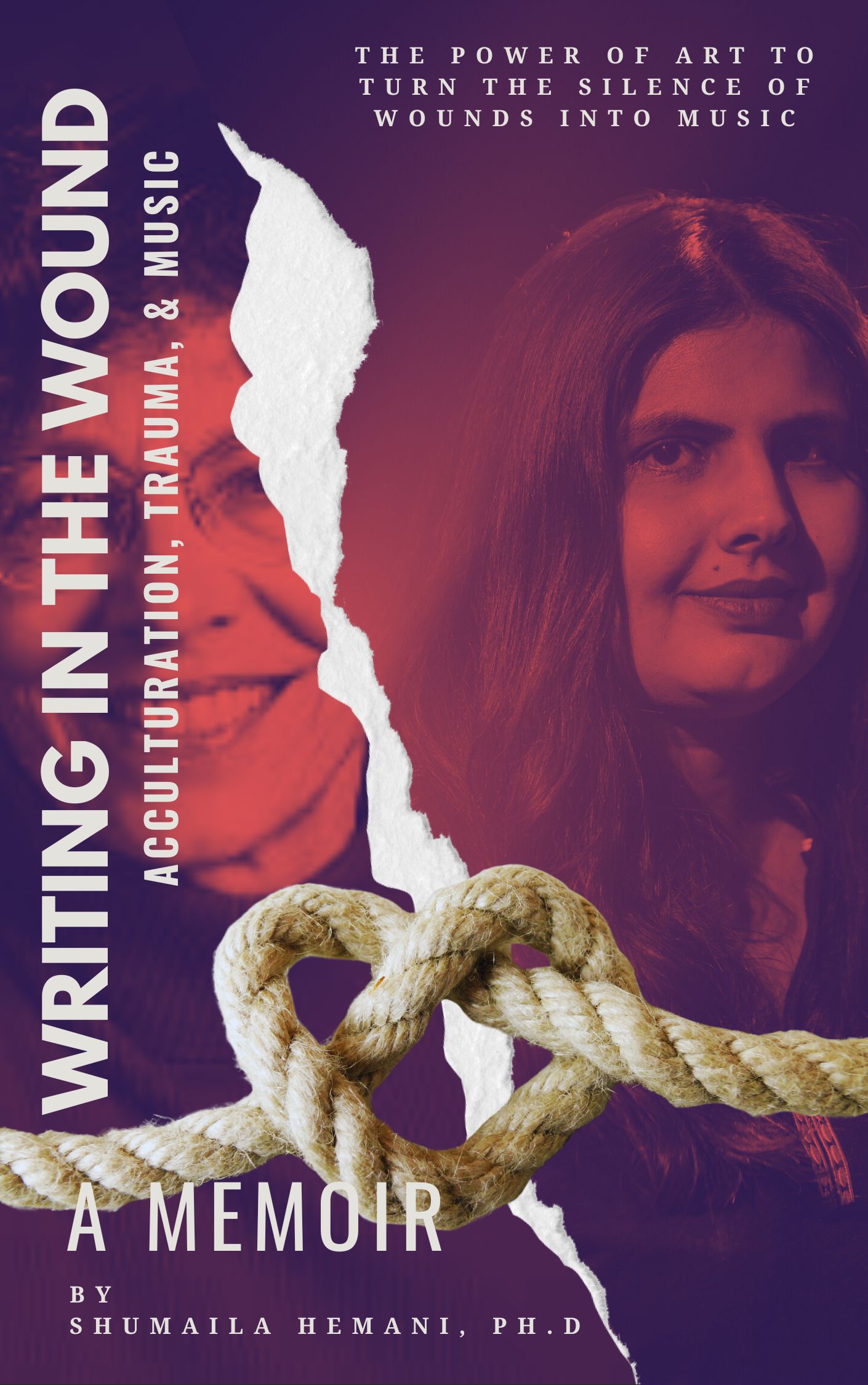
An Odyssey of Wounds That Carry Us Home
What happens when your scars begin to speak?
For Dr. Shumaila Hemani, music began as a calling. It unfolded into a life path through a rare human connection — with eminent ethnomusicologist Prof. Regula Burckhardt Qureshi — whose faith in her awakened the courage to risk everything for the artist’s path.
Writing in the Wound is a memoir of belonging, faith, and the sound of a woman healing from systemic exclusion amid the silences of immigration precarity.
“Shumaila Hemani ‘s work is multifaceted, beautifully lyrical, and crystal clear. She’s a gem in the Canadian arts community. ” Barb Howard, author of Happy Sands (University of Calgary Press)
About the Author

Dr. Shumaila Hemani (Ph.D., M.A., University of Alberta) is an award-winning ethnomusicologist, soundscape composer, and changemaker based in Alberta. A former Music Faculty member with Semester at Sea and the Faculty of Extension at the University of Alberta, Hemani’s work bridges music, ethnography, mental health, and social justice, earning her the Women in Music Canada Honour Roll (2023) and the Cultural Diversity Award (2016).
Her debut memoir, Writing in the Wound: Acculturation, Trauma, and Music, tells the story of surviving systemic exclusion and rebuilding a life through art. Blending memory, autoethnography, and poetry, it invites readers to listen to the wounds that shape us—and to the music that helps us heal.She has also published prose and poetry in The Goose, National Observer, the Conversation, Arts Desk (UK), and New Forum Magazine to name a few, and was nominated for the Alberta Magazine Awards (2022) in the Poetry category.
Hemani has delivered keynote talks and performances across Canada and the United States, using sound and storytelling to foster empathy, justice, and belonging. Her creative contributions include Alberta Musical Theatre’s A World of Stories (2020) and panelist in the Rapid Ideas panel at Puppet Theatre Calgary Festival (2025). She has served as Editor in Chief of Intontations-Graduate Music Journal at the University of Alberta, board member of the Arts for Social Change-Calgary Hub, and is an active member of Writers’ Guild, Alberta and the Canadian Authors Association.
Professional Affiliations


Table of Contents
Get a look at all of the content covered in the book. Everything you need to know is inside.
Chapters
1
The Voice and the Wound
4
Listening Across Thresholds
8
Take These Sunken Eyes and Learn to See
11
A Surgical Erasure
12
Bridging Worlds
32
The Ache of Visibility
35
The Wound as a Guide
43
Wind in my Sail
45
Parting With Ustād-e-Kāmil
49
A Lesson in Surrender
52
Once More, the Cranes Shall Return
58
Still Carrying the Wound
Excerpt from Writing in the Wound
“Some wounds don’t go away. They resurface and spiral through different points in life—silent reminders of lessons still waiting to be understood. They twist into the body like questions without answers, returning not to punish but to reveal what is still alive inside.
“Spiralling Wounds” from Writing in the Wound: Acculturation, Trauma, and Music
And when forgotten wounds haunt your nightmares—waking you in the middle of the night, not only as pain but as messengers—they demand attention. They are not just echoes of suffering. They are warnings. Invitations. Scarred whispers urging you to pause, to listen, to take them seriously.
Because sometimes the wound that reopens isn’t punishing you—it’s protecting you from walking into fire again.
Even as I reclaimed my voice and began to recognize the wound as teacher, another layer surfaced—one I hadn’t named. It didn’t speak in migraines. It arrived in recurring dreams.
Night after night, I was trapped in violent dreamscapes—visions of being chased, violated, overpowered. They weren’t literal memories. But they carried the emotional truth of a lifetime of precarity: moving through the world as a woman with no institutional protection, no safety net, no permanent belonging.
The dreams terrified me. But they whispered what my waking mind wasn’t ready to admit: the field—the place where I had once gone to listen and document—no longer felt safe. Not for my body. Not for my soul.
That was when I started really listening—unconventionally—to the intelligence within me that said: Your scars are speaking. Something is off.
Listening to those scars would change everything—how I moved, how I chose, and how I began to draw the boundaries that would save me.”
What readers said
★★★★★
“Shumaila Hemani ‘s work is multifaceted, beautifully lyrical, and crystal clear. She’s a gem in the Canadian arts community. ” Barb Howard, author of Happy Sands (University of Calgary Press)
★★★★★
“Writing in the Wound contributes to collective human strength to heal the planet — in such a loving, powerful way.” — Norine Braun, award-winning Indigenous singer-songwriter
★★★★★
“A powerful, deeply resonant work. I cannot wait to read the full memoir.” — Kenna Burima, Artist, Educator, and Performer
★★★★★
“Dr. Shumaila Hemani has made significant contributions to the community, yet remains in a state of immigration precarity due to systemic exclusion. Her memoir was featured in ActionDignity’s Echoes of Equity storytelling initiative, a platform that centres the voices of racialized workers and their lived experiences in the workplace.”
— ActionDignity, Echoes of Equity (September 2025)
★★★★★
Writing in the Wound stretches the boundaries of ethnography and ethnomusicology — a groundbreaking contribution to art and academia alike.
Poetic, intimate, and unflinchingly honest, it transforms lived experience into art.
Come with me as I take this story beyond the page.
-
Join upcoming readings, conversations, and performances inspired by Writing in the Wound.
[ Explore Events → ]
Stay Connected through Shared Listening and Care.
Let the Healing Begin. Enter the Wound.
Claim your Copy of the Book.

The Deep Listening Path is located on the traditional territories of the Treaty 7 peoples — the Blackfoot Confederacy (Siksika, Kainai, Piikani), the Tsuut’ina Nation, and the Îyâxe Nakoda Nations — as well as the Métis Nation of Alberta, Region 3. We honour the histories, stories, and soundscapes of these lands.
While Dr. Hemani’s memoir speaks to the trauma of 17 years of immigration precarity and prejudice in Canada, this experience is acknowledged within the longer and ongoing histories of Indigenous dispossession, colonial violence, and the urgent need to decolonize lands and institutions.
@ The Deep Listening Path Copyright 2025
