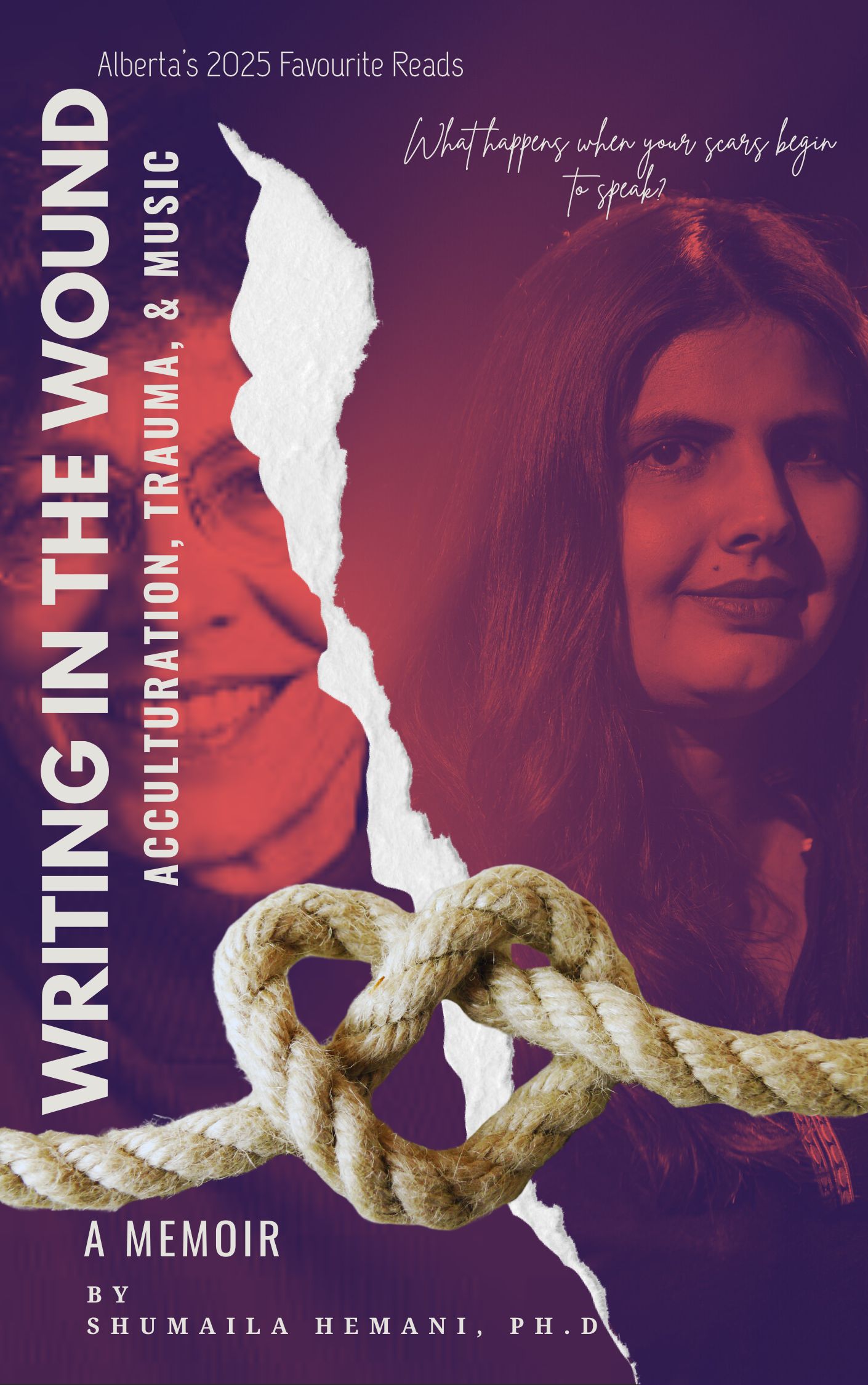
“Writing in the Wound: Acculturation, Trauma & Music by Shumaila Hemani in Alberta’s Favourite Reads (Westword Magazine, published by the Writers Guild of Alberta)


This fascinating memoir covers Hemani’s journey through three continents, her studies as an ethnomusicologist (way more interesting than you might think!), her growth and multiple awards as a Sufi poet and musician, and 17 years of being denied permanent residency by the Canadian government.”

— Barb Howard, Author of Happy Sands (The University of Calgary Press)

Featured in Alberta’s Favourite Reads 2025

What happens when your scars begin to speak?

What happens when her scars begin to speak?

Born in Pakistan and cast adrift in Canada’s immigration system after seventeen years of building a life there, Dr. Shumaila Hemani embarks on an odyssey through music, memory, and the enduring search for belonging. As she moves through institutions that promise recognition yet often demand silence, she confronts the fragility of artistic recognition and the realities of structural erasure, struggling to preserve her voice in systems that leave her visible but uncounted.

Blending lyrical storytelling, memoir, and autoethnographic reflection, Writing in the Wound traces Hemani’s journey from her ethnomusicological training under Professor Regula Burckhardt Qureshi at the University of Alberta to her apprenticeship with master Sufi musicians in Pakistan. Along the way, Sufi music becomes more than a spiritual calling—it becomes a form of resistance and a language for expressing what might otherwise remain unspoken.

At once personal and political, lyrical and scholarly, Writing in the Wound is a feminist memoir that invites readers to listen deeply—to the land, to longing, and to the courage of a Pakistani woman who subverts the silences of Canada’s immigration system, transforming her wounds into voice, music, and wisdom.

Writing in the Wound is not only about survival. It is the song of a woman reclaiming her power.

Hemani writes as if sound were breath, shelter, lineage, prayer, argument, and last defense all at once—deeply moving.” — Literary Titan

A fascinating memoir. Shumaila Hemani’s work is multifaceted, beautifully lyrical, and crystal clear.” — Barb Howard, author of Happy Sands (University of Calgary Press)

Writing in the Wound contributes to collective human strength to heal the planet—in such a loving, powerful way.” — Norine Braun, award-winning singer-songwriter

🏆 Silver Award Recipient — Literary Titan

“I found Writing in the Wound arresting, thought-provoking, and fiercely alive. Its ideas are forceful and, at their best, unsettling. Hemani’s central claim that exclusion is often discussed in abstract policy language while its damage is absorbed by actual bodies felt painfully persuasive. What stayed with me most was the book’s insistence that the ‘wound’ is not just a private sorrow but a structural fact, something lived in the body and sharpened by institutions, and that song can become not a cure exactly, but a way of bearing truth without surrendering to it.”

— Literary Titan, Silver Award

Show entire image uncropped

Dr. Shumaila Hemani

Dr. Shumaila Hemani, a creative non-fiction author based in Mohkinstasis (Calgary), Canada, is a former music faculty member at Semester at Sea and the University of Alberta. Described as “arresting, thought-provoking, and fiercely alive” (Literary Titan), her award-winning debut memoir, Writing in the Wound, explores a scholarly journey shaped by immigration uncertainty and was featured in the Alberta Favourite Reads (2025). A recipient of the Women in Music Canada Honour Roll (2023) and the Cultural Diversity Award (2015), and a PEN Canada Writer in Exile, Hemani is completing a human rights monograph with Routledge.

Featured in IHRAM Press’ Special Anthology on Hannah Arendt

Dr. Hemani’s story Catabasis was featured alongside 25 entries from Iran, Ghana, Pakistan, and the United States. Dr. Hemani also shared her journey to write this story in a special podcast interview with Professor Roger Berkovitz that will be featured as part of a Bonus Episode on June 5th on Reading Hannah Arendt with Roger Berkovitz.

“Such a powerful and deeply moving essay… What struck me most was the way CATABASIS gives narrative and emotional form to the precariousness Arendt identified at the heart of human rights: the condition of living without full political recognition or belonging. Your reflection on inhabiting a space between visibility and invisibility, voice and enforced silence, captures with extraordinary force the human reality behind Arendt’s insight that rights depend upon a political world willing to see and recognize us…profoundly impressed by your contribution.”

Newsletter Reflections

Monthly reflections on systems change and storytelling.

You have successfully subscribed to the newsletter

There was an error while trying to send your request. Please try again.

Dr. Shumaila Hemani — Shifting Systems through Storytelling & Sounds will use the information you provide on this form to be in touch with you and to provide updates and marketing.